Showing posts with label review. Show all posts

Friday, October 24, 2014

NSA Whistleblower Ed Snowden Documentary CITIZENFOUR is the Most Exciting Film of the Year

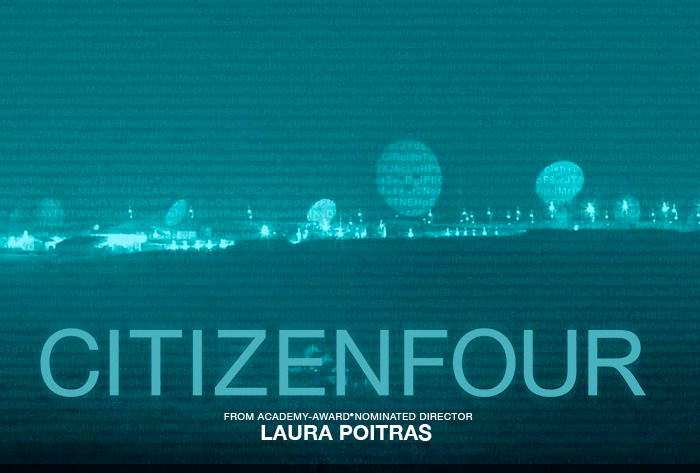
CITIZENFOUR is the new documentary by Laura Poitras, the first journalist whom National Security Agency whistleblower Edward Snowden contacted about unveiling documentation that the US government was collecting massive amounts of information on people throughout the entire world through their use of the internet, cell phones and telephone calls. Like a real life version of The Matrix, the film begins with a series of typed computer screen conversations between the then-unknown source, identifying themselves only as “Citizenfour,” and Poitras, who is instructed to verify the security of her computer systems before further contact can be made. We are also introduced to William Binney, the NSA cryptographer who quit after over 30 years of service to reveal that shortly after 9/11 the US government decided to begin spying on all American and world citizens, a decision that bore forth the programs Snowden revealed in 2013. Snowden passed information on to journalists revealing NSA court orders for an indiscriminant amount of information from major communications providers including Verizon, as well as the passive internet data mining systems PRISM and TEMPORA, the latter created by British intelligence organization GCHQ.

Scored with a minimalist soundtrack provided by Nine Inch Nails, CITIZENFOUR pulsates along with a simmering tension. An early scene shows with what would be otherwise innocuous footage of a construction site turn insidious when revealed to be that of an NSA surveillance facility in Utah. Judges in San Francisco get up in arms when a Department of Justice attorney suggests they shouldn’t intervene after it was revealed in 2006 the NSA was spying on AT&T customers and some of those customers decided to sue. It is against this political backdrop that Snowden enters the picture, agreeing to meet Poitras in a hotel in Hong Kong.

Anticipation couldn’t be higher for Snowden to emerge, the stakes meticulously built to great heights through Poitras’s voice-over narration and the steady unveiling of the circumstances of what is declared in CITIZENFOUR, “The greatest violation of civil liberties in the history of America.” Poitras is instructed to employ the help of journalist Glenn Greenwald, who joins her along with journalist Ewen MacAskill from UK newspaper The Guardian, in Hong Kong over the week in which Snowden unveiled the now infamous NSA documents. What unfolds over the course of that week is fascinating, scary, and often hilarious, sometimes all at once. Jason Bourne himself couldn’t think up all the spy hijinks Snowden pulls to protect himself, the journalists and the information he is passing on to them, and they are frequently extremely entertaining.

What CITIZENFOUR shows that hasn’t been known before is the thought process behind Snowden’s decision to expose himself as the source so soon after the NSA documents are reveled, but Snowden is resolute about taking a stand and putting a face to his act of defiance against what he considers unconstitutional government oppression. Throughout CITIZENFOUR loss of privacy is equated with loss of civil liberty, and though Snowden presses the idea that the real story is about the American government and not himself, his stepping out from behind the curtain was an act of personifying a particular notion of idealism, an act that CITIZENFOUR brings even more fully to fruition. It doesn’t hurt that Snowden is charismatic, photogenic and youthful, and that the last shot we see of him in Hong Kong before going off into the political wilderness to seek status as a refugee is of him decked out all in black, Neo-style, slicking back his hair with all the vanity of a typical millennial.

The rest of CITIZENFOUR is devoted to furthering the context of the past year regarding the NSA scandal, including the cell phone tapping of German Chancellor Angela Merkel. Meanwhile Glenn Greenwald, Ewen MacAskill and Laura Poitras all continue their investigative journalism regarding “national security reporting.” Snowden travels from Hong Kong to Moscow, Russia where his passport is cancelled while in the transit zone of the airport, and it is in Russia he is granted asylum. The final scenes of the film take place in Moscow, providing closure on the story of Snowden, but not on the larger narrative that he revealed to the world. That story is just beginning, and with CITIZENFOUR we have a thrilling introduction to a saga larger than life and stranger than fiction; In short, the most exciting film of the year.

Saturday, October 18, 2014

FURY is a Gritty Tar-Black War Thriller With Stellar Cast and Performances


Fury, the new war thriller from Sony Pictures Entertainment, written and directed by David Ayer, fires on all cylinders. “Wardaddy,” played by Brad Pitt in a career-defining turn, is a Sherman tank commander who must guide his crew into the heart of Nazi Germany at the end of World War II. Fury is the name of the Sherman tank “Wardaddy” commands, with members of her crew played by Shia LeBeouf as the preacher/soldier nicknamed “Bible” and Michael Peña as the Mexican-American soldier “Gordo.” Fury explores the psyche of this crew as they go up against unspeakable odds, waging their lives for the outcome of a war that’s already been decided.

Fury is an unrelentingly bleak film, from the stark setting of the desolate landscapes of Germany to the spiritual crisis “Wardaddy” and his crew experience dealing with the horrors of war. “It ain’t pretty, but it’s what we do,” “Gordo” explains to rookie soldier Norman, played by Logan Lerman, who is thrust into the cockpit of Fury as an assistant driver at the opening of the film. The crew of Fury are bound by harsh experience and an increasingly fatalist sense of duty, determined to destroy an enemy that’s been defeated but continues to fight. Norman enters this world green as can be, and is quickly schooled by “Wardaddy” in the art of Nazi-killing. The personification of innocence and naïveté, Norman functions as a foil to the perpetual guilt shared by the rest of the crew for the things they’ve done. In a long, centerpiece scene where Norman and “Wardaddy” befriend and have dinner with two German women in an apartment, the other members of the Fury crew crash the proceedings, chiding the idea that friendship with German civilians washes away past wartime transgressions. “Gordo” then recounts a scenario the crew experienced after a harrowing battle, acting as group confessor. They are men linked by shared experience, haunted by the weight of their supposedly righteous acts.

It’s these kinds of scenes that give Fury its gravitas, as it is essentially a handful of extended scenes bound together by sparse dialogue. The dinner scene serves as something of a centerpiece for the film, framed by the taut, explosive tank battles, which unfold with clockwork precision and high tension, as the crew of Fury work between themselves to survive against the Germans’ superior tanks. Much of the power of the actors’ performances lies in their world-weary faces; Pitt seems to be in a state of constant vigilance and fatigue, both inside and out of his tank. LeBeouf, as a preacher, frames the plight of the crew by suggesting the salvation offered by Jesus; The crew’s skepticism is undercut by the fact that salvation is so sorely needed. Acting as the conscience of the group, LeBeouf turns in a career-making role, preaching to the crew that what they are doing is the will of God while looking nothing less than a shattered man.

Though the sparse and straightforward nature of David Ayer’s script is refreshing given that war films are frequently overly ponderous with their dialogue as to the nature of war, at times it comes off as limited and clumsy. In a follow-up to the German dinner scene, “Coon-Ass,” played by Jon Bernthal, suggests to Norman that he is a “Good guy,” unlike the rest of the crew. It is this kind of contrived exposition where the film comes off as ham-handed and obvious, better suited for simmering ambivalence.

Thankfully there is still much ambivalence to be found, and though Fury is a bleak, harrowing tale of warfare, it is never less than spellbinding. A definite victory in the careers of actors Brad Pitt and Shia LeBeouf, Fury also showcases director/writer David Ayers as a force in barebones storytelling, both dialogue and visuals-wise, that portrays the pitch-black heart of his subject; In this case, the toll war takes on men.